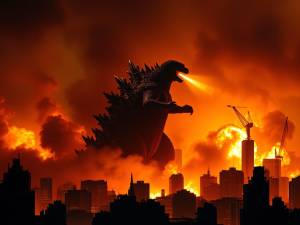

Godzilla is a kaiju. Godzilla is a gigantic creature that spits destructive rays, is unfazed by the barrage of high-tech weaponry, and marches forward while mercilessly destroying even the most sturdy modern urban buildings and infrastructure in its path. Although the literal translation of kaiju (怪獣) is mysterious beast, Godzilla should not be classified as a dinosaur or a monster.
The reason is that, Godzilla’s footsteps are reminiscent of the explosions caused by the bombs dropped during the Great Tokyo Air Raids (1944-1945), and Godzilla’s voice is not a menacing one but a scream of anguish and sorrow, reflecting the grievous suffering and lamentation of ordinary civilians whose skin had melted or been burned by the scorching blast of the atomic bomb, and who jumped into rivers to escape the extreme heat and quench their thirst and died.
Just before Japan was defeated in World War II in 1945, the country was devastated by bombings of its mainland and reduced to ruins. After the war, after desperate efforts at reconstruction, the first Godzilla film was released in 1954, just as the country was finally beginning to settle down.
Therefore, Godzilla scenes strongly reflect memories of the many wartime experiences, such as incendiary bomb air raids and atomic bombings.
Godzilla lands at night, just like in the Great Tokyo Air Raid, and spits radiation from his mouth, turning the surrounding area into a sea of fire. Alarm sirens ring out in the sleeping town, and Godzilla appears as a small silhouette against a backdrop of flames burning like an inferno. This scene is synchronized with the experience of a nighttime air raid, evoking a sense of unfathomable fear as an unknown, ferocious entity that human power cannot defeat suddenly appears out of the flames, similar to when a low-flying fighter plane suddenly appears in the darkness and drops countless bombs.
The day after Godzilla’s attack, at the temporary relief station set up inside the emergency headquarters, the injured are too numerous to be accommodated in the hospital rooms, spilling out into the halls and corridors, so crowded that it is difficult to walk. The moans of the seriously injured can be heard, as can the cries of children, the screams of relatives asking where they are, and a girl with a bandage on her head is being tested for radiation. When a Geiger counter is brought close, an eerie sound is generated, but the girl is unaware of what the reaction means.
It is said that one of the reasons for the creation of Godzilla was the fear and sense of danger of hydrogen bomb testing, so let’s take a moment to look back at this era.
After Germany’s surrender, the leaders of the United States, the Soviet Union, and the United Kingdom, who were on the Allied side in World War II, met in Potsdam, Germany on July 26, 1945, and decided to divide and rule Germany, recognize the Polish government supported by the Soviet Union, and divide Vietnam. This can be seen as a preliminary step to the later realization of the red team versus blue team hostile structure.
In addition, the three major countries at war with Japan, the United States, the United Kingdom, and the Republic of China, issued a joint statement demanding the unconditional surrender of all Japanese forces.
One of the most important events at the Potsdam Conference was when US President Harry Truman informed Soviet Premier Joseph Stalin that the US had successfully tested a weapon of extraordinary destructive power. Stalin apparently did not understand what Truman was talking about, but a few weeks later the US dropped atomic bombs on Hiroshima on August 6 and Nagasaki on August 9, 1945, forcing Japan to surrender.
Having demonstrated the devastating power of nuclear weapons, the United States suddenly found itself in the ascendancy of its allied powers. This then led to a struggle for hegemony between the Soviet Union, which was unhappy with the division of Europe after the war, and the United States, which began to implement policies to prevent the spread of Soviet ideology and influence.
Winston Churchill called the growing ideological and military wall between Eastern and Western Europe the Iron Curtain in a 1946 speech.
In 1947, shortly after the UK announced that it would cut off aid to Greece and Turkey, which were trying to suppress communist rebellions, US President Truman asked the US Congress for funds to support the two countries, and established a principle called the Truman Doctrine, which stated that the US should support countries and peoples threatened by Soviet troops or communist insurrections.
Stalin called this the beginning of the Shadow War, and the term Cold War was used as shorthand to describe the ideological struggle between capitalism in the West and communism in the East, which would last for more than four decades until the collapse of the Soviet Union in 1991.
The Soviet Union backed the coup in Czechoslovakia in 1948 and also initiated the blockade of West Berlin. At the time, Berlin was divided into an occupied zone with the communist East and capitalist West.
As a united front, the United States and its allies formed a transatlantic mutual defense alliance, the North Atlantic Treaty Organization (NATO), in 1949, while the Soviet Union formed its own defense alliance, the Warsaw Pact, in 1955. Incidentally, by creating a conflict structure between the blue team and the red team, the military-industrial complex’s exploitative system was effectively established, and this confrontational stance has since been utilized in various fields and areas.
Meanwhile, following the successful Soviet atomic bomb test in 1949, the United States began developing the hydrogen bomb as a nuclear weapon with greater destructive power than the atomic bomb.
On November 30, 1950, five months after the outbreak of the Korean War, U.S. President Harry Truman stated that the use of nuclear weapons on the Korean Peninsula was possible.
In 1952, the United Kingdom successfully conducted its first nuclear test.
In November 1952, the United States successfully tested a hydrogen bomb at Eniwetok Atoll in the South Pacific, a test that had been authorized by President Truman in January 1950. While atomic bombs use nuclear fission, hydrogen bombs, which use nuclear fusion, are said to have several times the destructive power of atomic bombs.
The Soviet Union successfully tested a hydrogen bomb in August 1953.
The United States ultimately conducted a total of 67 nuclear tests at Bikini Atoll and Eniwetok Atoll in the Marshall Islands between 1946 and 1958. US official documents declassified in 1984 revealed that radioactive fallout, known as death ash (死の灰), from the hydrogen bomb tests conducted at Bikini Atoll in March-May 1954 crossed the Pacific Ocean and reached Japan and the United States.
One of these was the first hydrogen bomb test, called Bravo, conducted on March 1, 1954, which was said to have 1,000 times the power of the Hiroshima atomic bomb.
Meanwhile, the reconstruction of Japan’s devastated society, economy and land was unexpectedly precipitated by the Korean War (1950~1953), and the economic growth that came from supporting the military needs of the United States continued until around 1957. This was known as the Jinmu Boom (神武景気), and as the 1956 Economic White Paper stated, “We are no longer in the post-war period,” favorable conditions such as expanding exports, stable prices, and monetary easing brought about a quantitative boom, and the image of the devastating post-war period was gradually dispelled.
Against this historical background, on March 1, 1954, the Japanese deep-sea fishing boat Daigo Fukuryu Maru (第五福竜丸), which was fishing near Bikini Atoll, was exposed to radiation from the American hydrogen bomb test. Despite being hit by a large amount of radioactive fallout, the fishing boat returned on its own, but one of the 23 crew members who were exposed to radiation died about six months later on September 23. Incidentally, according to documents declassified in 2015, 1,423 ships were exposed to radiation from the hydrogen bomb test.
Godzilla was produced as a result of the Daigo Fukuryu Maru radiation exposure incident.
Godzilla is depicted as a symbol of the horror of nuclear weapons created by mankind, and at the same time, as a metaphor for the threat of weapons of mass destruction (WMD) that only a country that has suffered nuclear attacks can recognize, synchronizing the horrific memories of war and air raids with the potential fear of a global nuclear war that could be brought about by the Cold War, long before the Cuban Missile Crisis (1962).
News of the hydrogen bomb tests at Bikini Atoll and the exposure to radiation on fishing boats such as the Daigo Fukuryu Maru was reported around the world, and movements and public opinion in favor of the abolition of nuclear weapons grew in countries around the world, including Japan.
Ironically, however, it was around this time that advocates for the peaceful uses of atomic energy began to take hold, as if to conceal or dispel the threat and fear of nuclear weapons. This can be seen as a struggle for supremacy (or a scheme for symbiosis) between the Red Team, which is promoting energy development based on nuclear energy interests, in opposition to the Blue Team, which controls the oil interests.
Incidentally, postwar Japan was occupied and governed by GHQ from 1945 to 1952, but this was not a direct rule but an indirect rule via the Japanese government. GHQ was led by Douglas MacArthur (1880-1964, Freemason, 33rd rank, the highest rank in the Scottish Rite).
After executing Tojo Hideki (東条英機) as a Class A war criminal, GHQ immediately released other Class A war criminals (or suspects) such as Nobusuke Kishi (岸信介), Yoshio Kodama (児玉誉士夫), Banboku Ohno (大野伴睦), Ryoichi Sasagawa (笹川良一), and Matsutaro Shoriki (正力松太郎), and had them involved in implementing occupation policies, including the five major reforms.
At this time, anti-nuclear sentiment was at its peak all over the world, but in Japan, government agencies that were puppets of GHQ and people like Matsutaro Shoriki likely received instructions to suppress the opposition and ultimately get the whole of Japan excited about the future of atomic energy.
The first pro-nuclear maneuver was made by Katsuo Okazaki (岡崎勝男), who served as Minister of Foreign Affairs from 1952 to 1954, when he announced the Japanese government’s policy of cooperating with the United States in conducting hydrogen bomb tests, despite criticism from anti-nuclear activists and the public.
Following this policy, Shoriki began to actively promote the pro-nuclear movement, and as part of his promotion of the peaceful uses of atomic energy, he exhibited the Daigo Fukuryu Maru at the Isetan department store in an effort to dispel fears about the damage caused by radiation exposure.
In any case, it is unlikely that a single politician would come up with the idea of peaceful use of atomic energy on their own, and it is difficult to imagine that they would suddenly ignore the wishes of their fellow citizens who have survived the brutal destruction of war out of mere personal arrogance, so it can be inferred that these covert operators are speaking and acting in accordance with the instructions of the rulers.
Incidentally, by the 1950s, the CIA had formalized techniques for infiltrating major media organizations and exerting social influence, known as Operation Mockingbird. Based on techniques refined in wartime propaganda activities, the Mockingbird techniques were established as an evolving template for information manipulation that still influences everything from news coverage to entertainment programming today. Most recently, it was used to fabricate the coronavirus crisis, induce social unrest, and get the commoners to pander to the rulers’ schemes, so this may come to mind.
In fact, it can be inferred that Shoriki’s mission from GHQ included establishing media such as the Yomiuri Shimbun and Nippon Television, and using psychological manipulation based on the so-called 3S policy to remove the rebellious spirit of the people and weaken them both mentally and mentally. It was revealed in a CIA declassification in 2007 that Shoriki was a secret intelligence agent given the code name PODAM by GHQ.
Let’s get back to the topic of Godzilla.
Godzilla was born as a victim of a hydrogen bomb experiment conducted by humans. However, after landing in Tokyo, Godzilla mercilessly destroys the urban structures in his path as he advances, and so Godzilla, who was once a victim, becomes an assailant against humanity.
This was a time when, with the start of the Cold War, GHQ’s policy shifted from demilitarization to reconstruction based on economic policies, and the construction of urban infrastructure and modern buildings was progressing.
The defense forces attack Godzilla with bullets and cannons in an attempt to thwart his advance. However, no weapon works on Godzilla, who survived the hydrogen bomb.
A plan to electrocute Godzilla with a powerful 50,000-volt current also fails, and instead, the radioactive incandescent light that Godzilla spits from his mouth causes the electricity pylon to instantly heat up and melt. This is reminiscent of the buildings and people that melted in the intense heat of the atomic bombs in Hiroshima and Nagasaki.
Meanwhile, the paleontologist’s daughter recalls the results of research on the Oxygen Destroyer, which a pharmaceutical chemist showed her on the condition that she not disclose it to anyone, and which has more destructive power than a hydrogen bomb.
The Oxygen Destroyer is a liquid oxygen destroyer that instantly destroys oxygen in water and suffocates and dissolves all living things. The pharmaceutical chemist discovered it by chance while studying oxygen from every angle, and told the paleontologist’s daughter that he would not make it public until the day came when it could be used for peaceful purposes.
Tokyo has been reduced to scorched ruins, and the paleontologist’s daughter, concerned that the radioactive contamination caused by Godzilla will reach the children being cared at the temporary relief center, and unable to bear the horrific scene unfolding before her eyes, decides to break her promise to the pharmaceutical chemist and reveal the secret of the Oxygen Destroyer to her boyfriend.
They go to see the pharmaceutical chemist and desperately beg him to let them use it to defeat Godzilla, but he firmly refuses, stating that if a precedent of its use is ever set, it could later be misused as a weapon of mass destruction.
However, moved by the images he sees on television of the devastation in the town, the suffering of the victims, and the voices singing prayers for peace, the pharmaceutical chemist agrees to use it on the condition that it is a one-time use only, and incinerates all documents relating to the Oxygen Destroyer.
This suggests that Godzilla was also a question about the ethics, ideas, and morals of scientists.
In fact, as science and technology became indispensable in war, scientists were mobilized and various preferential treatment was given to researchers, and scientists responded to this.
After the war, even the dropping of the atomic bomb by the United States was talked about as a victory of American democracy over fascism, and scientists were the only ones who were able to survive unscathed from wartime to peacetime without being held responsible for the war or seriously reflecting on their actions. For example, it is said that after the war, Nazi scientists were invited to the United States and the Soviet Union and given preferential treatment.
In Japan, as one social trend, a democratization movement organization called the Association of Democratic Scientists was established in 1946, mainly by Marxists, and being scientific came to be seen as progressive and democratic. Meanwhile, coupled with the return of prewar capitalists to society, the initiative of scientific researchers was lost, and the independence and autonomy of scientific research was also damaged, and scientific research was rapidly incorporated into the monopoly capitalist system.
Furthermore, Japan entered a period of rapid economic growth in the late 1950s, and people were beginning to feel a desire to forget the horrible memories of the war and to aim for a bright future through reconstruction. In other words, people were leaving behind memories of the horrible past and pre-modern traditions and customs, and moving forward with the expectation that reconstruction through progress and modernization based on the latest science would bring about a prosperous future.
In response to such social trends, which submit to the capital and policies run by the rulers, regard research into natural science as an absolute good, and equate scientific progress with social progress, the pharmaceutical chemist in the Godzilla film showed that science can sometimes damage the dignity of nature and humanity and lead to destruction, and that strict ethics and a sense of responsibility are essential as a deterrent to counter this view of science and society.
Godzilla, which was released in 1954, is a science fiction film aimed at the masses as entertainment, but when we look back at the current state of science and nature, and science and humanity, that has come to the forefront as a result of the virus turmoil, it can also be said that this work shows the need for each and every individual to sincerely raise their awareness.
To raise awareness, one must make one’s consciousness and senses more clearly functional and ascend to an awakened state. To become aware is to awaken and to be enlightened, and also to become aware of the truth. Enlightenment can be said to mean stepping out of the darkness of ignorance and into the brightness of intellect and understanding, and a parable in Book 7 of Plato’s Republic (c. 375 BC) gives the impression of visualizing the mechanism behind this.
Plato uses the metaphor of the cave to explain becoming aware of the truth.
—–
A fire is lit behind the prisoners who are tied up facing the cave wall, and the prisoners spend their time watching the shadow pictures of people and animals projected on the wall.
One day, one of the prisoners is freed and forced to look towards the light of the fire behind him, but it is too bright for him to see. He is told that what he sees in the light is correct, but he believes that the shadow pictures are the truth.
Next, the prisoner is forced out of the cave and shown the actual landscape in daylight, but it is too bright for him to see anything. However, he gradually gets used to it and is able to see the view under the sunlight, and realizes that humans can live truly happy lives in the natural scenery outside the cave.
The prisoner returns to the cave and tries to tell his fellow prisoners about the outside world, but they laugh at him for going crazy after being outside, and stop him from encouraging them to leave the cave.
The prisoner returns to the cave and decides to live with his fellow prisoners again in order to teach them about the beauty of the outside world and true happiness.
—–
In this story, the process of awakening is divided into three stages.
1. Those who live in the cave are people who have not yet awakened, and who believe that what they see with their eyes is the whole world and that this is the truth. Nothing that is visible is real, it is merely an illusion. In society, this illusion is everything that makes up society, such as countries, laws, systems, and money. People who believe that this illusion is the truth will be trapped in society and live without questioning the social structure.
2. Those who are able to see the side opposite the wall have awakened from the illusion. They see the actual puppets in front of the light, and then they realize that the shadow projected on the wall has no substance, and that what they had seen up until then was merely an illusion created by a mechanism.
3. Those who are able to break free from illusion and step outside the cave to see the beautiful and majestic reality of the world with its sunlight and natural abundance are enlightened beings, who have also ascended to a higher level of consciousness and spirituality.
After awakening to the truth of the outside world, the prisoner returns to the cave and tries to explain what he has realized to his fellow prisoners and lead them outside, but his fellow prisoners do not take him seriously, saying that his words are bizarre and out of line, and even capture him and try to kill him.
This awakened savior who returns to the cave from the outer world of light is said to be Plato’s teacher, Socrates. In fact, Socrates taught philosophy in Athens but was executed by the rulers for corrupting the youth.
In any case, it is certain that a deeper understanding can be gained by looking at the essence behind things, rather than being satisfied with just looking at the surface.
The shadows cast on the cave walls can be equated with the excessive amount of information that is spread in modern times through the Internet, social media, news coverages, etc. This information may reflect some truth, but in order to understand the essence, it is necessary to investigate and verify the bias, deception, and veracity of the information we receive, and acquire the ability to discern the truth.
To do this, it is essential to acquire the ability to recognize the outside of the cave through lifelong learning and self-development to expand one’s knowledge and broaden one’s horizons.
Plato’s allegory of the cave is not just a philosophical lesson, but it provides an opportunity to realize the limitations of our understanding of the current situation and to think deeply about how we perceive information, how we live, and what it means to pursue the truth in modern society.
Godzilla represents the fragility of commoner society, which is excited about reconstruction, in a social system based on the malicious schemes of destruction and reconstruction by the rulers, and the social unrest brought about by sudden changes in circumstances and conditions that could occur at any time.
Destruction would include not only war, but also the spraying of artificial viruses and toxic substances, artificial weather, fires, and earthquakes, the elimination of traditions and customs, and the pollution and elimination of the natural environment. Moreover, the trigger is almost always not accidental, but deliberate, such as a false flag or the use of DEW.
Reconstruction would include not only construction, but also prescribing harmful medical procedures in response to the artificial viruses and toxic substances, and transforming society into a strict surveillance society, depriving people of their inherent human rights and freedoms. In other words, in most cases, it can be inferred that land grabbings, social system reform, depopulation, etc. are all carried out based on deliberate schemes by the rulers.
It can be said that the time has come for each and every commoner to make the effort to get out of the cave, lest they be misled by the schemes hatched by the covert operatives dispatched by the rulers.
Sincerely grateful for your financial support.
Sources and references:
Part One: The Architecture of Control
FBI, DEA Deployment of AI Raises Privacy, Civil Rights Concerns
Yale Study Confirms One Billion Vaxxed Now Have ‘Full Blown VAIDS’
vs.
Flu vaccines are neither safe nor effective
vs.
Russia accuses U.S. of expanding biological weapons research in Africa
Russia Claims Africa is The New Focus For US Biolab Activities